
Your AI, your subscription
The assistant you already pay for does the thinking; Statly never bills you for AI usage. Research processing uses Research Tokens, an allowance included in the plan — not AI tokens.
Research → Backtest → Paper → Live
Your own AI authors the strategy over MCPBuilt for the people who measure before they act.
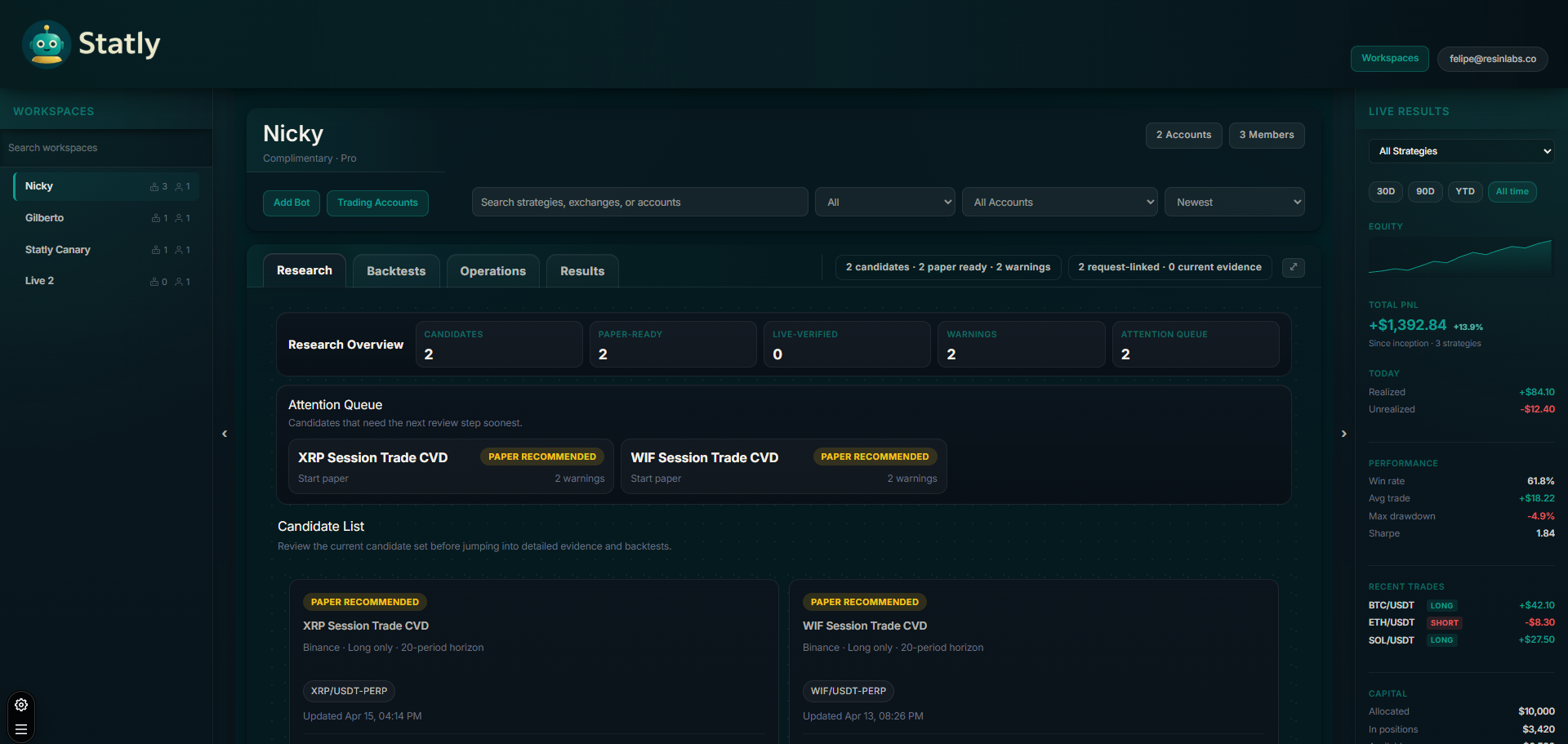
Connect Claude, ChatGPT or any MCP-capable assistant to your Statly workspace. It reads the research catalog, composes the rules, saves a strategy version and asks for the evidence. No Statly chatbot, no second engine: the version your assistant saved is the one that runs in backtest, in paper and, when you say so on the website, live.
The assistant you already pay for does the thinking; Statly never bills you for AI usage. Research processing uses Research Tokens, an allowance included in the plan — not AI tokens.
Read, author, execute and cancel are separate approvals on the Statly consent screen. None of them reaches an order, an exchange key or a live deployment — that path does not exist through MCP.
Versions, jobs, results and trial history live in your workspace, not in a chat. Close the conversation, switch assistants, come back next month — the work, the holdout policy and the attempt count are exactly where you left them.
What your assistant reads through MCP is shared with that AI provider under its terms.
Nine live data lanes from Binance and Hyperliquid feed one pipeline: collect, label on two decision horizons, compute 26+ features daily, and validate through eight fail-closed gates. The verdict is net post-cost Sharpe on two independent holdouts — everything else is a diagnostic. This catalog is what your assistant reads before it writes a single rule.
Live data across both,
execution on your own accounts.
Nine live streams from Binance and Hyperliquid, across twelve perpetual-futures symbols. What the venue printed is what gets tested.
Each gate fails closed: a candidate without complete evidence is refused, and the serving boundary refuses anything without a passed packet. These are rejection bars — not promises.
Purged, embargoed chronological folds plus truncated-tape and correlation screens — future data can't leak into past tests.
If one latent factor explains more than 80% of the variance across symbols, the candidate is rejected.
Reference class, base rate, pre-mortem, and the economic rationale — written down before the verdict, not after.
Per-symbol notional ceilings sized to real book depth — a pattern must hold up at the size customers actually run.
Scored across volatility, trend, and liquidity-stress regimes — no single-weather patterns.
Deflated Sharpe and combinatorial overfitting probability on purged folds — luck gets discounted, not rewarded.
Every attempt is counted in a persistent ledger. The more we try, the higher the bar automatically gets.
The decisive test: portfolio Sharpe net of fees, funding, and slippage — on two independent holdouts, both re-run at 1.5× costs.
Both tiers must pass, and both must survive a 1.5× cost-stress re-run. Fail either, and the candidate never reaches the catalog.
Three-month holdout across all twelve symbols — the first bar every candidate must clear.
Six-month holdout on the longest-history symbols — consistency over time, not just lately.
Your assistant submits a saved strategy version; Statly runs it against frozen historical data — pinned to a manifest, partition IDs and the exact commit — so any result is re-runnable and auditable, on the website or back in the chat. Empirical evidence about the past, never a promise about the future.
Same version, same partitions, same commit — same equity curve. No hidden randomness, no look-ahead.
Equity curve, drawdown, per-trade ledger, and behaviour by regime — pinned to the run that produced them, so anyone can verify.
Sweep parameters in one pass, rank by post-cost Sharpe, stress under heavier costs. Each survivor is its own saved version, and earns the next rung: paper.
A saved version climbs a one-way ladder — paper, then live — and only you advance it: signed in on the website, with the account, capital and limits in front of you, bound to that exact version. Your assistant can prepare; it can never activate. Statly is non-custodial: your own API keys, no withdrawal permission, no discretionary trading on your behalf.
The same saved version runs forward on live data with realistic costs before a dollar is at risk — same rules, same position logic, same cost treatment as the backtest.
Your own Binance and Hyperliquid keys, scoped without withdrawal. Statly never holds your funds — not an exchange, broker, or wallet.
Nothing goes live automatically, and nothing goes live from a chat. Statly runs only the version you activate on the website, inside the limits you set. A later edit is a new version — the one that is live never changes underneath you.